Level of Evidence Pyramid for Systematic Reviews
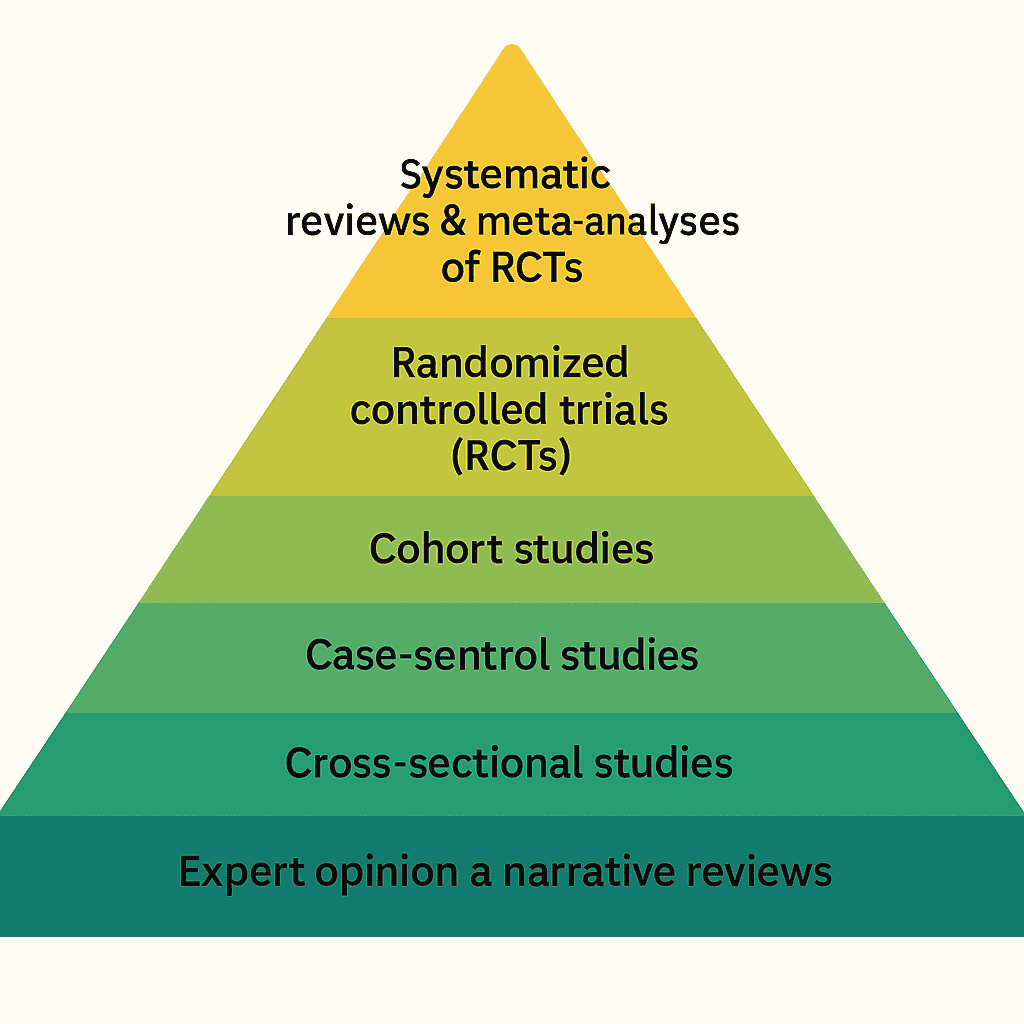
The “level of evidence pyramid” orders study designs by the level they occupy in the evidence hierarchy. A level is the starting strength of a design for one kind of question. It is not a quality score for a particular study.
For treatment benefits (the question “does this intervention help?”), the Oxford Centre for Evidence-Based Medicine (CEBM) 2011 Levels of Evidence uses five levels. Level 1 is a systematic review of randomized trials or n-of-1 trials. Level 5 is mechanism-based reasoning. GRADE is a separate certainty framework you apply after appraisal.
Treatment-benefit levels, in one line: Level 1 systematic review of randomized trials or n-of-1 trials; Level 2 randomized trial or observational study with dramatic effect; Level 3 non-randomized controlled cohort/follow-up study; Level 4 case-series, case-control studies, or historically controlled studies; Level 5 mechanism-based reasoning. On this row, a randomized trial is Level 2, not Level 1.
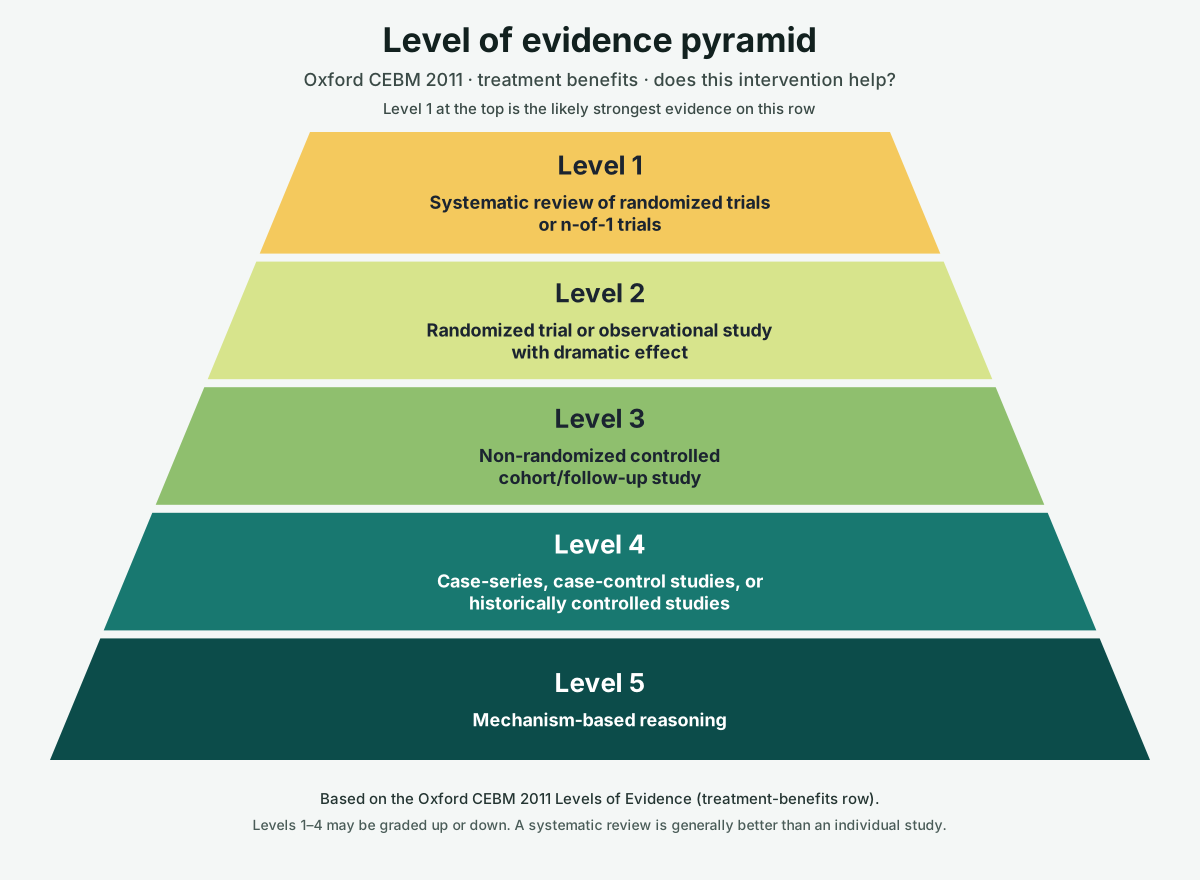
Level of evidence pyramid for treatment benefits. Level 1 is at the top. Source: Oxford CEBM 2011 Levels of Evidence, row “Does this intervention help? (Treatment Benefits)”.
Levels for treatment benefits
CEBM’s 2011 table has a different row for each question. The levels below are only “Does this intervention help? (Treatment Benefits)”. Diagnosis, prognosis, harms, and screening use other designs. The March 2009 CEBM table is a different grid: it subdivides levels (1a, 1b, 1c) instead of these five steps.
| Level | Study design | Short description |
|---|---|---|
| 1* | Systematic review of randomized trials or n-of-1 trials | First step on this row. The 2011 explanation calls the left-hand step the likely strongest evidence. |
| 2* | Randomized trial or observational study with dramatic effect | Second step. An observational study is listed here only when the effect is dramatic. |
| 3* | Non-randomized controlled cohort/follow-up study** | Third step. The double asterisk says a systematic review is generally better than an individual study. |
| 4* | Case-series, case-control studies, or historically controlled studies** | Fourth step. The same double asterisk applies. |
| 5 | Mechanism-based reasoning | Fifth step on this row. The printed header for this step has no asterisk. |
* Level may be graded down on the basis of study quality, imprecision, indirectness (study PICO does not match questions PICO), because of inconsistency between studies, or because the absolute effect size is very small; Level may be graded up if there is a large or very large effect size.
** As always, a systematic review is generally better than an individual study.
The 2011 explanation says: “The likely strongest evidence is likely to be found furthest to the left of the Levels, and each column to the right represents likely weaker evidence.” The pyramid draws that order with Level 1 at the top. CEBM publishes a table, not this picture.
Source: OCEBM Levels of Evidence Working Group. “The Oxford 2011 Levels of Evidence.” Oxford Centre for Evidence-Based Medicine. Table: CEBM Levels of Evidence 2.1 (PDF). Background: Explanation of the 2011 OCEBM Levels of Evidence. Levels page: OCEBM Levels of Evidence.
Example (teaching, treatment benefits): start at Level 1 when a systematic review of randomized trials exists. The asterisk means that level can still be graded down after you read the studies. A Level 3 non-randomized controlled cohort can suggest an effect and still be more exposed to confounding. Record the level in an evidence table as its own field, then appraise the study with a quality-assessment tool.
TL;DR
The pyramid on this page is the Oxford CEBM 2011 treatment-benefits row: five levels, from a systematic review of randomized trials (Level 1) to mechanism-based reasoning (Level 5). It is a starting order for that question, not a quality score for an individual study.
Key rule:
- level of evidence = starting design strength for a question type
- quality/risk of bias = how well a specific study was actually done
What the evidence pyramid is
The pyramid on this page is a drawing of one row from the Oxford CEBM 2011 table. CEBM publishes that row as steps from left to right. The drawing puts Level 1 at the top and Level 5 at the base.
It tells you where causal inference usually starts for a treatment-benefit question. It does not tell you that a study was done well. The asterisk on Levels 1–4 is the table’s own caveat: a level can be graded down for study quality, imprecision, indirectness, inconsistency, or a very small absolute effect, and graded up for a large or very large effect size.
One sentence for your protocol
Use this wording in plain language: “Design hierarchy tells us where causal inference usually starts; risk-of-bias and certainty methods tell us where we end up after reading the actual studies.”
Why beginners find it useful
It helps with four early decisions:
- which designs to prioritize in inclusion criteria
- what to expect from the literature landscape
- how to frame confidence in conclusions
- how to structure evidence tables for synthesis
If you are new to full workflow design, pair this with What Are the 7 Steps of a Systematic Review?.
Not all pyramids are the same diagram
The numbered pyramid on this page is one row of the 2011 table. Other sources draw different layers.
- This page: treatment benefits only. Level 1 is a systematic review of randomized trials or n-of-1 trials. Level 5 is mechanism-based reasoning.
- Same 2011 table, other questions: a diagnosis question starts with “Systematic review of cross sectional studies with consistently applied reference standard and blinding.” A prognosis question starts with “Systematic review of inception cohort studies.” Common harms and rare harms have their own rows. Do not copy the benefit numbers onto those questions.
- The previous CEBM table: the 2011 explanation says levels 1a, 1b, and 1c were replaced with a single Level 1, and that economic and decision analyses were left off the revised table.
- Teaching sketches: some put expert opinion or narrative reviews along the base. That is not Level 5 of the 2011 treatment-benefits row.
For a single intervention review, the practical question is narrower: which eligible designs can support the causal claim your review question implies? Everything else is commentary unless your scope explicitly widens.
When the pyramid shape changes (same idea, different ordering)
| Review question type | Why the default “RCT on top” picture can mislead |
|---|---|
| Treatment efficacy / harm | RCTs and high-quality overviews often lead, but harms and long-term outcomes still need careful appraisal. |
| Diagnostic accuracy | Cross-sectional or cohort designs comparing test to reference standard may dominate; “RCT at top” is the wrong mental model. |
| Prognosis | Longitudinal cohorts may be the best available evidence even when no trial exists. |
| Qualitative evidence | Synthesis of qualitative studies answers different questions; design “levels” from trials do not replace methodological rigor frameworks for qualitative work. |
Takeaway: the pyramid is a map of typical starting strength, not a universal ladder stamped on every clinical question. The numbers on this page apply to treatment benefits. When randomized trials cannot answer an intervention question, Cochrane Handbook chapter 24 says authors may be justified in including non-randomized studies, and that potential biases are likely to be greater than for randomized trials, so those results need cautious interpretation.
Where people misuse it
Mistake 1: assuming top-level design means high quality
A weakly run RCT can be less trustworthy than a strong cohort study.
Mistake 2: dismissing lower-level evidence completely
For rare conditions or early technologies, lower-level evidence may be the only available evidence.
Mistake 3: using hierarchy as the final verdict
Design hierarchy should be combined with risk-of-bias assessment and certainty reasoning.
Mistake 4: counting studies instead of information
Ten small, biased trials do not automatically outrank one well-conducted study that directly matches your PICO and outcomes.
Pyramid vs quality assessment
Think of it like this:
- pyramid = map of where evidence starts
- risk-of-bias tool = check of how evidence was produced
- certainty approach (for example GRADE) = integrated confidence judgment
For tool selection, use How to Choose the Right Quality Assessment Tool.
Glossary (quick reference)
| Term | Plain-language meaning |
|---|---|
| Study design | Planned structure of the study (trial, cohort, case-control, etc.). |
| Risk of bias | Systematic ways the study could deviate from the truth (selection, performance, detection, attrition, reporting, confounding). |
| Precision | How tight estimates are; often driven by sample size and event counts. |
| Directness | How closely outcomes, populations, interventions, and comparators match what you care about in practice. |
| Consistency | Whether separate studies point in the same direction. |
How to use the pyramid in real reviews
During protocol design
Specify which designs are eligible and why.
During screening
Tag study design early to understand evidence mix.
During extraction
Capture design and key quality fields in the same table.
During synthesis
Interpret effects in light of design strength and bias risk, not just p-values.
Linking hierarchy to evidence tables
In practice, teams that separate design label from appraisal result avoid the most common pyramid mistakes:
- One column (or structured field) for design type, including the row you used (for example “CEBM 2011 treatment benefits, Level 2”).
- Separate fields for risk-of-bias domain judgments and an overall appraisal.
- Outcome-level notes where indirectness or imprecision matters for GRADE-style reasoning.
That structure mirrors how Evidence Table Builder is intended to be used: keep extraction structured enough that downstream quality and certainty judgments are traceable in the same row as the effect estimate or narrative finding.
Quick practical checklist
- Have we defined eligible design types in protocol?
- Do we track design type as a structured field?
- Do we assess risk of bias separately from design level?
- Are conclusions aligned with certainty, not only study count?
- Have we stated which “pyramid” logic applies to our question type (treatment vs diagnosis vs prognosis)?
If any answer is no, your hierarchy logic is probably incomplete.
Frequently asked questions
Does “higher on the pyramid” always mean “include it, lower means exclude it”?
No. Eligibility is a protocol decision. Some reviews intentionally include lower-level evidence when trials are sparse, with explicit rules for interpretation.
Should we use the pyramid instead of RoB 2 or ROBINS-I?
No. The pyramid is not a substitute for domain-based risk-of-bias tools. At best it informs which tool family you are likely to need.
Is a randomized trial Level 1 or Level 2?
On the Oxford CEBM 2011 treatment-benefits row, a randomized trial is Level 2. Level 1 is a systematic review of randomized trials or n-of-1 trials. An observational study is Level 2 on this row only when the effect is dramatic. Other rows, and the older subdivided CEBM table, number designs differently.
Does this pyramid have a Level 7?
This treatment-benefits row has five levels. It does not define a Level 6 or a Level 7.
Do systematic reviews always sit “above” RCTs?
On this row, a systematic review of randomized trials is Level 1 and a randomized trial is Level 2. That is a starting order, not a guarantee. The asterisk allows Level 1 to be graded down, and a review is only as trustworthy as its included studies, methods, and risk-of-bias assessments. A bad overview can mislead faster than a single good trial.
Where does GRADE fit?
GRADE (or similar) integrates risk of bias, inconsistency, indirectness, imprecision, and publication bias for quantitative estimates—exactly the dimensions the pyramid does not encode by itself.
Final thought
The evidence pyramid is a useful starting framework, not a decision machine. Use it to orient your review, then combine it with structured extraction and quality appraisal to make defensible conclusions.
Related reading
Tags:

About the Author
Connect on LinkedInGeorge Burchell
George Burchell is a specialist in systematic literature reviews and scientific evidence synthesis with significant expertise in integrating advanced AI technologies and automation tools into the research process. With over four years of consulting and practical experience, he has developed and led multiple projects focused on accelerating and refining the workflow for systematic reviews within medical and scientific research.