Resolving Dual-Extraction Disagreements: A Field-Level Adjudication Ladder
Goal
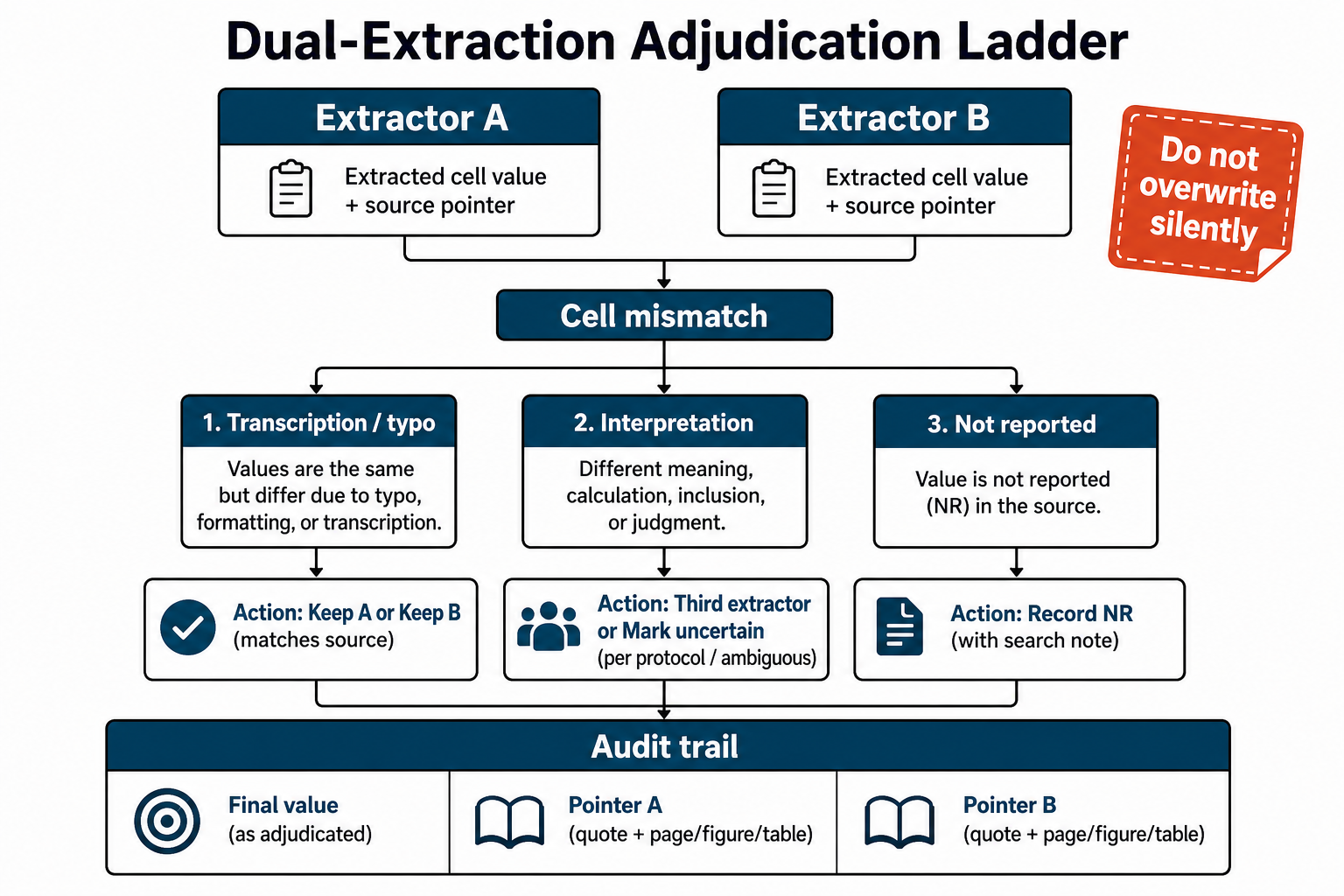
Provide a fast, defensible ladder to resolve cell-by-cell disagreements between two human extractors, while preserving a source-linked audit trail. Keep it mechanical: classify, decide, record — no silent overwrites.
Ladder overview
- Cell mismatch detected → 2) Classify the disagreement → 3) Apply the decision rule → 4) Record resolution in the audit trail (final value + both source pointers).
1) Classify the mismatch
- Transcription/typo
- One value reproduces the source; the other is a slip (digit transposed, unit copied incorrectly, punctuation stripped).
- Examples:
- Sample size: A=412, B=410; PDF table shows n=410.
- Dose: A=10 mg, B=10 µg; PDF: 10 mg.
- Interpretation
- Both values exist in the paper but reflect different choices (population set, timepoint, unit convention, rounding, per-protocol vs ITT).
- Examples:
- Follow-up: A=12 weeks vs B=90 days; both appear.
- N: A=410 ITT vs B=392 PP; both reported.
- Missing in source / Not reported (NR)
- At least one extractor entered a value that is not demonstrably present in the paper.
- Examples:
- Compliance rate present? A=78%, B=NR; no rate anywhere in text/tables.
2) Decision rules
- If Transcription/typo
- Keep the value that matches the source verbatim.
- If scan quality or OCR is ambiguous, escalate to a third extractor.
- If Interpretation
- Apply the protocol rule first (e.g., prefer ITT over PP; prespecified primary timepoint; SI units; rounding to source precision).
- If protocol is silent and both are defensible, escalate to a third extractor; otherwise mark “uncertain” with rationale.
- If Not reported
- Record “NR” (or the project’s standard null token) and include a short search note (sections/pages checked). Do not impute.
3) Audit trail — how to record the resolution
- Final value: the resolved cell value (including “NR” when applicable).
- Evidence pointers: keep both extractors’ original source pointers (quote + page/figure/table). If one was wrong, still keep its pointer for traceability.
- Rationale: 1–2 words are enough (“typo—kept B”, “protocol: ITT”, “NR after search”).
- Callout: do not overwrite silently. Adjudication must leave a row-level footprint. For verbatim quotes and source pointers in the export, see the audit trail feature.
4) Escalation triggers
- Low-quality scan, conflicting tables, or OCR artifacts.
- Protocol conflict (e.g., competing unit conventions).
- Safety-critical fields (primary outcomes, N, mortality events).
- Repeated disagreements by the same extractor (training/feedback needed).
Worked examples
- Sample size (Transcription/typo)
- A=412, B=410; Table 1 shows n=410. Decision: keep 410. Audit: final=410; pointers=[A: none/incorrect, B: Table 1 p.3]; rationale=“typo—kept B”.
- Timepoint (Interpretation)
- A=12 weeks, B=90 days; Methods specify primary analysis at 12 weeks; Results include a 90-day sensitivity. Decision: keep 12 weeks per protocol. Audit: final=12 weeks; pointers=[A: Methods p.5, B: Results p.9]; rationale=“protocol: primary timepoint”.
- Adverse events rate (Not reported)
- A=18%, B=NR; no AE rate in text/tables; only raw counts without denominator. Decision: NR. Audit: final=NR; pointers=[A: claimed value—no source, B: —]; rationale=“NR after search (pp.3–7)”.
Related
If you’re trialing automation alongside humans, see also: Automated Data Extraction for Systematic Reviews (HEOR & Market Access). This ladder is strictly for human–human adjudication and auditability.
Tags:

About the Author
Connect on LinkedInGeorge Burchell
George Burchell is a specialist in systematic literature reviews and scientific evidence synthesis with significant expertise in integrating advanced AI technologies and automation tools into the research process. With over four years of consulting and practical experience, he has developed and led multiple projects focused on accelerating and refining the workflow for systematic reviews within medical and scientific research.